
The check that exposes the most fakes when it comes to spotting an authentic Fendi bag isn’t the serial number — it’s the FF monogram. On a genuine Fendi, the pattern stays aligned even where the leather or canvas has been cut and stitched back together — at the corners, either side of a zip, under the flap — because the pieces are cut specifically to make the motif match up. On copies, the pattern shifts by half a centimetre, and once you know to look for it, it jumps out immediately. After that come the interior tag, the metal hardware, and the price. The authenticity card matters far less than most people assume: it’s a piece of card, and card gets printed.
The numbers back up why it’s worth looking closely. According to a study by the EUIPO, the European Union Intellectual Property Office, published in June 2026, counterfeiting drains roughly €640 million a year from the legitimate bag, jewellery, and watch market in Italy alone, and €1.7 billion from clothing. Thirteen percent of Europeans admit to knowingly buying a fake — twenty-six percent among 15 to 24-year-olds. Everyone else bought one believing it was genuine. Here we’re sticking to Fendi specifically.
The FF monogram: Zucca, Zucchino, and the most common mistake
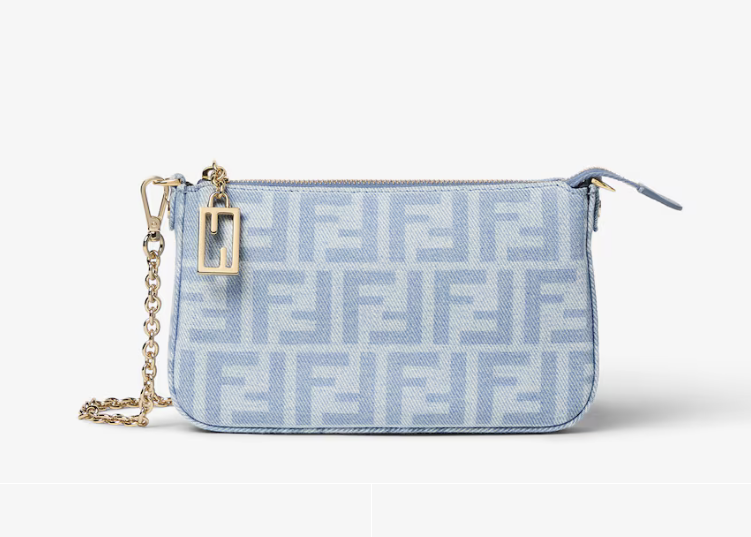
The double F was born in 1965, when Karl Lagerfeld joined Fendi. It’s made of two letters: one upright, the other flipped and mirrored below it — hence the nickname “upside-down pumpkin”.
There are two versions of the same motif, and the difference isn’t a collector’s technicality: the Zucca is the large-scale version, with the double F legible from a distance; the Zucchino is the small, dense version that reads more like a texture than a logo from afar, used mostly on pouches, mini bags, and small leather goods. Sellers of fakes often confuse the two, or mix the proportions on the same piece.
On an authentic bag, every FF block is exactly the same size and spaced the same distance apart — line them up mentally and they’d match perfectly. The letters are crisp, with one arm shorter than the other, no smudging or frayed edges. And crucially, the pattern continues without a break across seams, zips, and corners: this is what copies get wrong most often, because matching the pattern up costs wasted leather and extra cutting time.
One caveat: don’t stop here, because plenty of Fendi bags carry no monogram at all. A smooth-leather Peekaboo or a Selleria piece has nothing to align, so for those you need to look elsewhere.
Leather, coated canvas, and Cuoio Romano
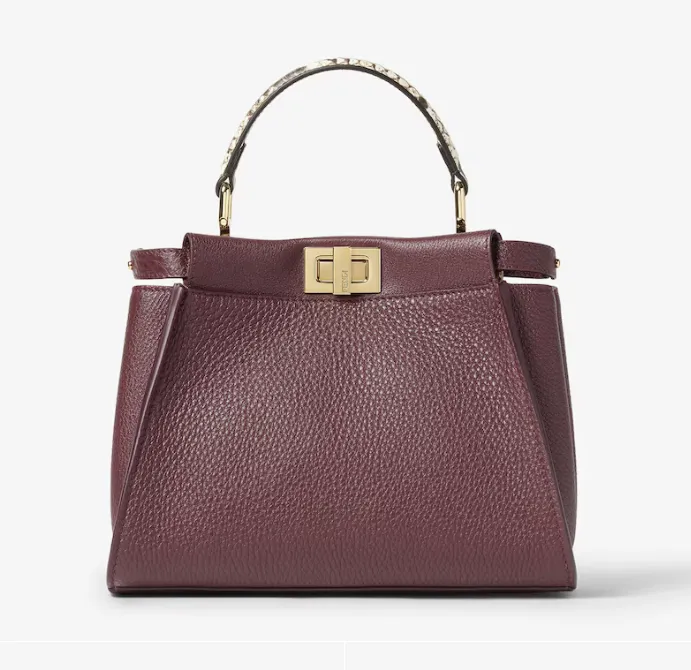
Fendi was founded in 1925 in Rome, on Via del Plebiscito, as a leather and fur workshop run by Adele Casagrande and Edoardo Fendi. That artisanal origin is still visible in the Selleria line, the hardest to imitate well: thick Cuoio Romano leather that softens with wear, and stitching done by hand, one stitch at a time.
There’s a detail you can verify yourself, and it’s unusual: on the official website, the product name itself states how many hand stitches went into the bag. You’ll see descriptions like “Selleria bag with 192 hand stitches”, or 266, or 1,254 on larger pieces. Every Selleria piece also carries an engraved metal tag with a unique serial number and the year 1925. On a copy, hand-stitching is faked by machine: the stitches come out identical, perfectly parallel, and spaced at exactly the same distance. A craftsman’s hand is even, not geometric.
On coated-canvas bags, the fabric should feel compact and matte, with a slightly stiff hand-feel, never shiny and slippery like plastic. Embossed leathers should show an irregular pattern, because the hide isn’t stamped identically throughout. It’s the same logic we covered when discussing Saffiano and Re-Nylon in our guide to spotting a fake Prada bag: the material, touched, almost always tells the truth before the labels do.
The interior tag, serial number, and chip
Inside every bag there’s a tab carrying the identification code. On a genuine bag it’s made of leather, never fabric or card, and it’s sewn into a seam, in a corner, or inside a pocket. The number is stamped into the back, not printed on the surface.
It’s a long alphanumeric code, typically fifteen to seventeen characters, often broken up by hyphens; the same tag also shows the model code, the colour code, and the “Made in Italy” mark. The lettering should be even and well spaced — squashed letters, poor alignment, or stamps of inconsistent depth are a bad sign.
Then there’s the part that confuses people most. Between 2004 and 2010, Fendi applied a holographic sticker carrying the serial number inside its bags. From the early 2010s, it replaced that with an RFID chip sewn into the fabric label, which holds the production data and can only be read with equipment available in boutiques. Finding both on the same bag is a serious warning sign — the exact transition dates vary by line and Fendi has never published them, so it isn’t mathematical proof, but if a seller shows you a hologram and a chip together on a recent bag, that’s reason enough to stop and question it.
One thing Fendi doesn’t do: offer any online service where you type in the serial number and find out if the bag is genuine. No website promising that check is official. For a genuine concern, go through customer service or an independent authenticator. It’s exactly the same pattern we found while covering how to spot a fake Chanel bag: luxury houses simply don’t offer online verification, no matter how much of the web claims otherwise.
Baguette, Peekaboo, and Selleria: what to check on each
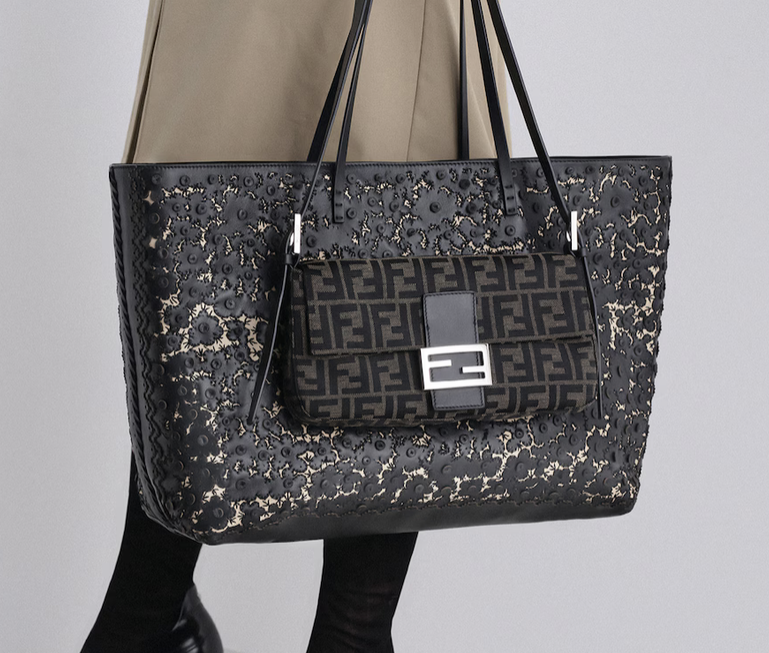
The checks shift from model to model, and knowing where to look saves time.
- Baguette — designed by Silvia Venturini Fendi in 1997, meant to sit under the arm like a loaf of bread, with over a hundred thousand pieces sold in its first year and cemented into pop culture by Sex and the City in 2000. Here, check the FF buckle: it should be heavy, with a sharp, deep engraving, and centred on the flap. The code is usually found in the main compartment.
- Peekaboo — introduced with the spring/summer 2009 collection, built around two compartments, one closed and one that can be left open to reveal the contrasting lining. The twist lock should click shut with a sharp, quiet snap and no wobble. The code usually sits near the interior divider.
- Selleria — a numbered metal tag, hand-stitching, Cuoio Romano leather. This is the line where fakes fall apart fastest, because the workmanship takes hours no counterfeiter has any interest in spending.
Two rules apply across every model. Hardware on a Fendi bag feels heavy in the hand, has an even finish, and shows no spots where the plating wears through to reveal the metal underneath; magnetic snaps are typically square and carry the double F or the full logo. And zippers should glide smoothly with no catching, and the puller shouldn’t wobble.
Price, and where to buy the real thing
Price remains the fastest filter of all. On the official site, a leather Baguette starts at roughly €1,950 in the mini size and runs around €3,000 in the classic version; a Peekaboo ISeeU Small sits around €4,500–4,700. On the authenticated secondhand market, classic canvas and leather models start from a few hundred euros and easily exceed a thousand, depending on model, material, and condition.
That means a “new” Baguette offered for £120 isn’t a bargain — it’s a different bag altogether. And the reverse holds too, unfortunately: a high price guarantees nothing, since high-end copies are deliberately priced at believable figures precisely so they don’t raise suspicion. Price rules things out; it doesn’t confirm anything.
There are three safe channels: boutiques and the official Fendi website, department stores and authorized retailers, and secondhand platforms that physically authenticate the piece before shipping it. Buying from a private seller on social media, with no guarantees and no returns, means the risk is entirely yours.
FAQ
Does Fendi let you verify a serial number online?
No. Fendi doesn’t provide any page or app where you can type in a serial number and get confirmation. Websites promising this service aren’t official. For a genuine concern, contact Fendi’s customer service or an independent authenticator.
Is a Fendi bag without an authenticity card definitely fake?
No, and the reverse isn’t true either. The card is a piece of printed cardstock, easy to reproduce, so its presence proves nothing; likewise, on secondhand pieces it’s extremely common for the card to have been lost over years of changing hands. Far more telling are the leather tag sewn inside, the quality of the hide, and how well the monogram lines up.
What’s the difference between Zucca and Zucchino?
They’re the same motif at two different scales. The Zucca is the large double F, legible from a distance; the Zucchino is the small, dense version that reads as a texture from afar and is used mostly on small bags, pouches, and wallets. In both versions, the lower letter is flipped and mirrored relative to the one above it.
What does it mean if a bag has both the holographic sticker and the chip?
It’s a signal worth taking seriously. The holographic sticker belongs to bags from 2004–2010; the RFID chip sewn into the label came afterward. Finding both on a recent bag is almost always a sign of a copy that overdid it — though the exact transition dates were never officially published and can vary by line, so it isn’t mathematical proof on its own.
How much does a genuine Fendi bag cost?
On the official site, a leather Baguette starts at roughly €1,950 in the mini size and runs around €3,000 in the classic version, while a Peekaboo ISeeU Small sits around €4,500–4,700. On the authenticated secondhand market, classic models start from a few hundred euros and easily exceed a thousand depending on model, material, and condition.
Prices checked in August 2026 on the official Fendi website and major authenticated resale platforms; they may change.
Disclosure: this article may contain affiliate links. If you buy through these links, Purse & Co may earn a small commission, at no extra cost to you.