
Spotting an authentic Chanel bag starts with three details that fakes almost always get wrong: the quilting, which on a genuine bag continues aligned even across the back and sides; the CC turn-lock, where the right C sits over the left one at the top and under it at the bottom; and the serial number, which since 2021 is no longer a sticker but a microchip. From there, what matters is the leather, the weight of the hardware, and whether the interior stamp matches the metal finish. Here are the checks, one by one, in the order that makes most sense.
The leather: lambskin, caviar, and what changes to the touch
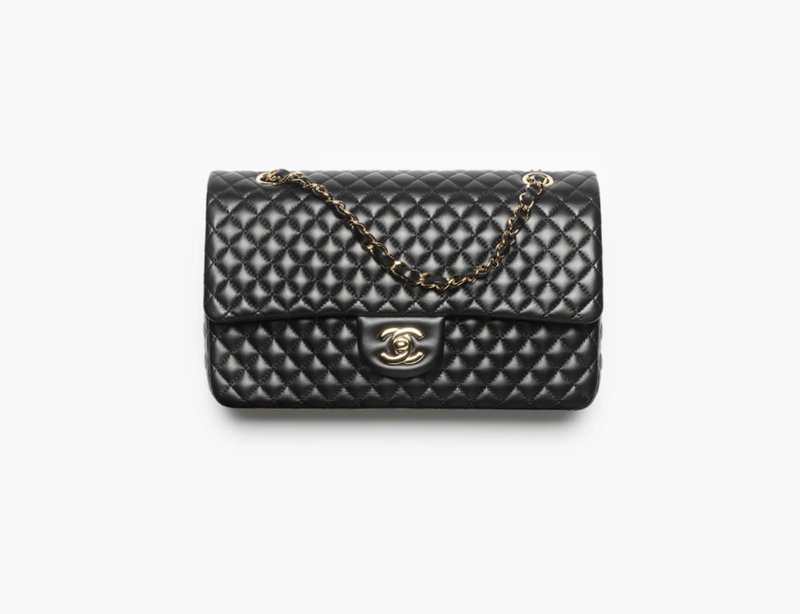
The first check happens with your hands. Chanel works mainly with two leathers, and being able to tell them apart already filters out a lot. Lambskin is smooth, extremely soft, with a satiny, matte sheen: it’s the most beautiful leather and also the most delicate, since it marks easily. Caviar is pebbled calfskin, with a small, even raised grain, far more resistant to scratches and rain.
On fakes, the caviar grain is almost always printed onto a synthetic material: gently flex a section and the texture flattens out and goes smooth, whereas on real leather it holds. Fake lambskin, on the other hand, tends to be too shiny and rubbery, with a chemical smell instead of tanned leather. Weight helps here too: a leather Chanel bag holds its shape on its own and doesn’t sag the moment you set it down.
The quilting, the stitching, and the chain
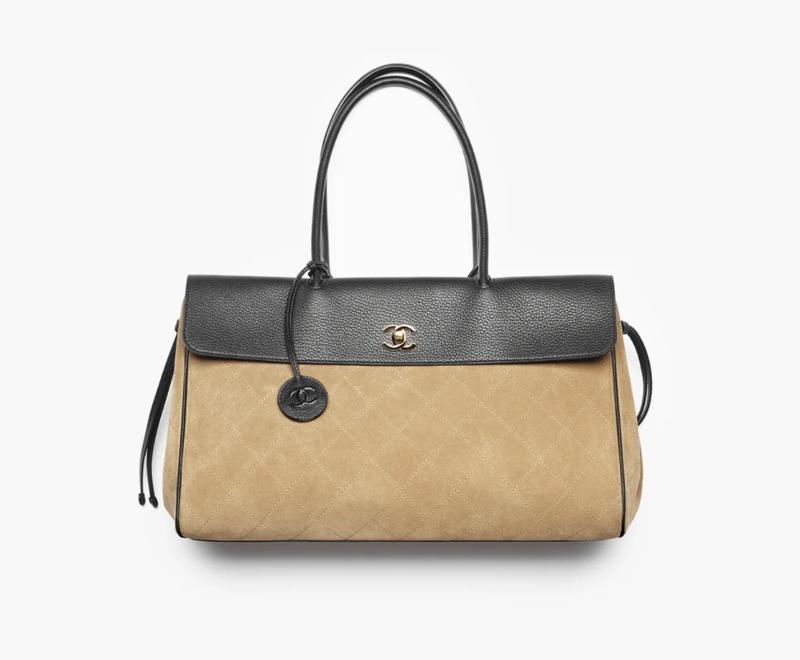
The diamond quilting is where an imitation gets exposed fastest, because doing it properly takes time, and counterfeiters don’t spend the time. On an authentic bag, the diamonds are symmetrical and aligned across the seams: the pattern on the front continues uninterrupted onto the sides, the back, and the rear pocket, as if the bag were cut from a single sheet. Any break in the pattern, even a small one, is a warning sign.
Also look at the stitch density: each side of a diamond should show ten stitches or more, short and even, since tight stitching is what stops the leather from puffing up into a pillow shape. Long, sparse, or crooked stitches don’t come out of a Chanel workshop.
The chain deserves its own check: the links are heavy and well finished, and the leather strip runs through the links continuously, with no glued-on segments or visible joins. On copies, it’s often a thin strip that breaks off and starts again.
The CC lock, hardware, and interior stamp
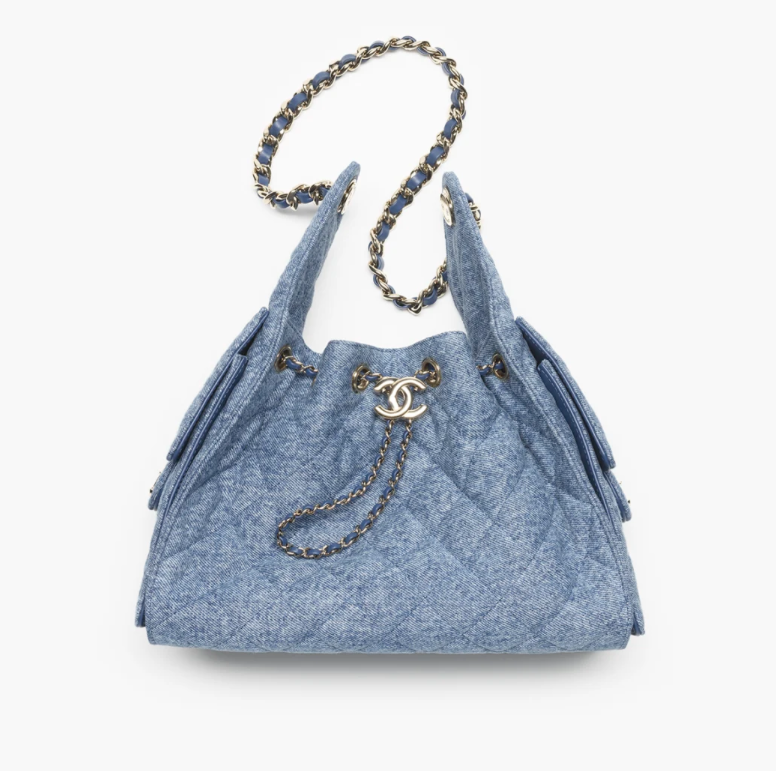
On the turn-lock there’s a rule that never changes: the right C sits over the left C at the top, and the left C sits over the right at the bottom. It’s a precise crossover, and getting it backwards — or making it symmetrical — is one of the most common mistakes on fakes. The two C’s should also be of uniform thickness, with rounded ends rather than pointed ones.
Authentic hardware is heavy and has a warm, slightly satiny finish, not the yellow mirror shine of cheap brass. The lock mechanism turns with a clean, precise click and no wobble.
Inside, the stamp reads CHANEL and, below it, either MADE IN FRANCE or MADE IN ITALY — those are the only two options, so a “Made in Paris” stamp is an instant giveaway. The lettering should be crisply stamped, straight, and evenly spaced, and the colour of the stamp should match the hardware finish: gold with gold, silver with silver. A bag with gold-tone hardware and a silver stamp doesn’t add up.
Serial number, hologram, and microchip: what changed in 2021
This is where a lot of buyers get thrown off, because many guides still describe the system as it was a decade ago. Chanel introduced serial numbers in 1984, as a sticker applied inside the bag: six digits until 1986, seven digits from 1986 to 2005, eight digits from 2005 onward. The serial is never longer than eight digits, and stickers from the later years carry an iridescent hologram and an anti-tamper X-cut that tears if someone tries to peel it off.
Since April 2021, with the 21A collection, that system was retired: instead of the sticker, Chanel now sews a metal plate holding a microchip under the lining, and the old black authenticity card with gold trim is no longer issued. That gives you one very useful rule of thumb: an authentic Chanel bag never has both the serial sticker and the microchip, so a bag presented as a 2022-or-later collection that still shows the old sticker is a problem.
That said, don’t ask the serial number to prove more than it can. There is no public database where you can type in the number and get an answer — websites promising to “verify a Chanel serial number online” are selling a service the brand doesn’t offer. Even the microchip can only be read with the house’s own tools, and boutiques will not authenticate bags purchased elsewhere. The number is one piece that needs to be consistent with everything else, not the decisive proof on its own.
Classic Flap, 2.55, or Boy: what to look for by model
The general checks always apply, but each model has its own signature, and it’s worth knowing which one you’re looking at, since copies often blur the three together.
- Classic Flap (11.12) — has the double-C turn-lock and the chain woven with leather. It’s the model with the double interior flap, and by far the most imitated.
- 2.55 reissue — fitted with the Mademoiselle clasp, rectangular and logo-free, with an all-metal chain. A CC turn-lock on a bag sold as a 2.55 is a mistake by whoever copied it: they’re two different closures for two different models.
- Boy — identifiable by its squared buckle with a raised CHANEL wordmark, and a chunky, flat-linked chain with leather woven through only part of it.
If you’re considering your first secondhand Chanel, the practical advice is to start with a caviar Classic Flap: it’s the most well-documented model, so the easiest to get authenticated, and the leather that holds up best over time. Lambskin is more beautiful but scratches easily, and on a secondhand piece you risk paying for damage that never goes away. On fabric, tweed, or denim styles, the quilting remains the main thing to check.
Price, and where to buy the real thing
Price is the most honest filter there is. Chanel doesn’t publish a single global price list, and figures vary by country due to VAT, currency, and leather choice, but the order of magnitude is well known: after the April 2026 price increase, a medium Classic Flap sits at roughly €10,500–11,000 in Europe. For current pricing and models in production, the best source is the official Chanel website.
With those numbers in mind, a “brand new, tags on” Chanel bag for a few hundred pounds simply doesn’t exist — that price doesn’t even cover the leather. Secondhand, the caution stays the same but the scale shifts: a 20–40% discount on a recent model is plausible, a 90% discount never is. And this isn’t only a problem for individual buyers — according to the EUIPO, the European Union’s intellectual property office, counterfeit bags, jewellery, and watches drain roughly €2.7 billion a year from the legitimate market.
In practice: buy from a boutique, an authorized retailer, or a secondhand platform that authenticates pieces before they ship. Insist on real photos rather than catalogue images — the lock up close, the interior stamp, the back of the bag to check the quilting alignment — and be wary of listings with a single photo. A seller acting in good faith is happy to send them; one who gets irritated is already telling you something.
More from Purse & Co
If you’re building out your knowledge of authentication basics, we’ve also covered how to spot a fake Louis Vuitton bag and how to spot a fake Gucci bag — the details change, but the method stays the same.
FAQ
Where is the serial number on a Chanel bag?
On models up to 2021, it’s a sticker applied inside the bag, often in a pocket or along the edge of the lining, protected by a film with a hologram and an X-cut that tears if someone tries to peel it off. From the 2021 collections onward, it’s replaced by a metal plate holding a microchip, sewn under the lining.
Can you verify a Chanel serial number online?
No. Chanel doesn’t provide any public database to check a serial number, and websites promising this service are offering something the brand doesn’t provide. Even the microchip can only be read with the house’s own tools, and boutiques won’t authenticate bags bought elsewhere.
How do you recognise the authentic CC lock?
The right C sits over the left C at the top of the logo, while at the bottom the left C sits over the right. The two letters are of uniform thickness with rounded ends, the metal is heavy with a satiny finish, and the mechanism turns with a clean, precise click and no wobble.
Is a Chanel bag without an authenticity card fake?
Not necessarily. On pieces a few years old, the card may simply have been lost, and on bags from 2021 onward Chanel no longer issues one at all, having replaced it with the microchip. The reverse is also true: the card gets counterfeited along with the bag, so on its own it proves nothing. What counts is the sum of the details, not a single card.
How much does a genuine Chanel bag cost?
After the April 2026 price increase, a medium Classic Flap sits at roughly €10,500–11,000 in Europe, with differences between countries due to VAT and currency, and variation based on leather and finish. Secondhand, a 20–40% discount on a recent model is normal, while a price of a few hundred pounds for a bag presented as new is almost always a sign of counterfeiting.
Disclosure: this article may contain affiliate links. If you buy through these links, Purse & Co may earn a small commission, at no extra cost to you.