
Spotting an authentic Prada bag always starts in the same place: the triangle. On genuine bags, the inverted triangle plaque sits straight, is attached with no glue bleeding out at the edges, and reads “PRADA” cleanly engraved, with “MILANO” and “DAL 1913” beneath it. From there you move to the leather (Saffiano has a tight, even cross-hatched texture), the inner lining with its rope motif alternating with the brand name, straight stitching, and heavy metal hardware with an engraved logo. The price tells the rest of the story: below a certain threshold, a “new” Prada bag simply doesn’t exist. Here are the checks, one by one, in the order that makes most sense.
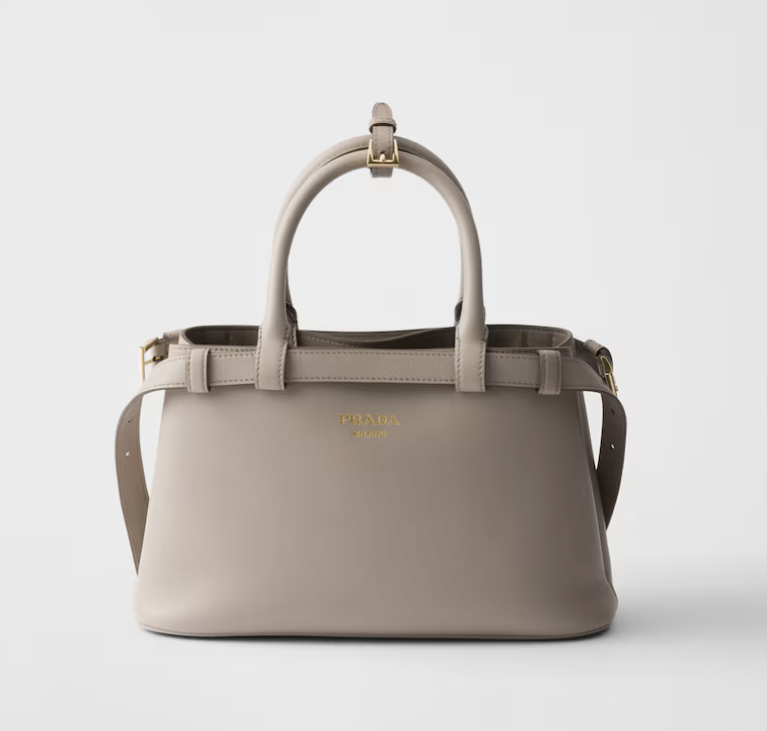
Materials: Saffiano leather and Re-Nylon
The first check happens with your hands, before your eyes even get involved. Saffiano is the house’s signature leather: embossed calfskin with a cross-hatched texture, wax-finished to make it compact and resistant to scratches and water. On an authentic bag, that texture is tight, even, and — crucially — continuous: it carries on identically over corners, edges, and handles, without breaking up or flattening out where the leather bends.
On fakes, the same texture is almost always printed onto a synthetic material, and you can spot it by gently flexing a section: the embossing “flattens out” and goes smooth, the material feels like plastic under your fingers, and the smell is chemical rather than tanned leather. Weight helps too: a leather Prada bag stands up on its own and doesn’t sag the moment you set it down.
On the fabric side, Prada nylon isn’t what it was in the ’90s. Since 2019, the house has introduced Re-Nylon, a regenerated yarn made from recovered plastic waste, which has gradually replaced virgin nylon across the collections. It’s a matte, very compact fabric that holds its shape; imitations use shiny, lightweight nylon that wrinkles immediately.
The triangle, the logo, and the lining
The inverted triangle is the most copied element — and also the one that most often gives fakes away. On a genuine bag, the enamelled metal plaque sits aligned with the bag’s axis, with sharp corners and no trace of adhesive around the edges. It reads “PRADA” and, in the full version, “MILANO” and “DAL 1913” — the year Mario Prada opened his shop in Milan’s Galleria Vittorio Emanuele II.
Look closely at the typography, because that’s where counterfeits slip up. The letters are capitals, evenly spaced and of uniform thickness; the “R” has a distinctively drawn leg, with a small opening that fakes tend to render too closed or too rounded. Smudged or unevenly spaced lettering is a red flag on its own.
Then open the bag. Many models have a jacquard lining with a precise pattern: one row with the rope motif alternating with a row of the repeated Prada wordmark, often flipped upside down on alternating rows. The fabric is structured and the pattern crisp, aligned with the seams. Imitations use smooth linings, printed with a blurry design or with the pattern cut off halfway at the edges.
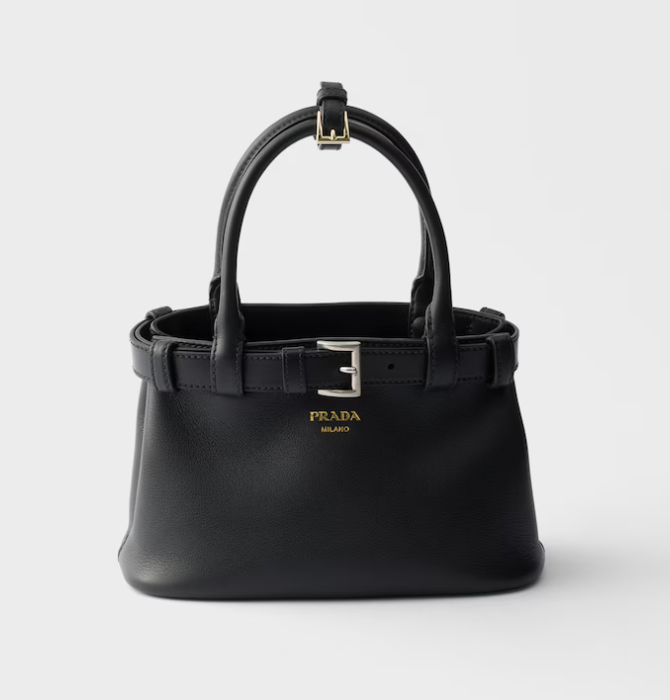
Stitching, finishing, and hardware
A well-constructed bag shows in the stitchwork, and you don’t need any technical expertise to see it — just hold it up to the light. On a genuine Prada bag, the stitching is straight and tight, with stitches of equal length that mirror each other on both sides, no dangling threads or visible knots; the leather edges are finished and dyed evenly.
Hardware is the other test. Buckles, feet, clasps, and clips are solid metal: they feel heavy in the hand, have a consistent finish, and carry the “PRADA” wordmark engraved in capitals, crisp and legible. On fakes, the metal is light, tends to chip within a few weeks, and the engraving looks rounded or shallow.
One detail few people know about concerns the zippers. Prada doesn’t manufacture its own zips — it fits components from specialist suppliers such as Lampo, Riri, YKK, Opti, and Ipi, whose name appears engraved on the back or side of the puller. Finding one of these names isn’t proof the bag is authentic, but finding none of them on a zip that runs stiffly and feels hollow is a fairly reliable warning sign.
Serial number, authenticity card, and tag
Inside the bag — usually in a pocket or on a leather tab sewn to the lining — Prada bags carry a label with an alphanumeric code: the imprint should be crisp, aligned, and free of smudging. Bags sold in recent years also come with an authenticity card, a laminated white card showing the logo, a number, and model details, along with the care booklets.
Here an honest clarification is needed, because a lot of confusion circulates online: Prada does not offer any public service to verify a serial number online. Anyone promising an “official serial check on the website” is describing something that doesn’t exist. If you have a genuine doubt, there’s only one correct route: contact the brand’s customer service or bring the bag to a boutique or authorized retailer, as outlined in Prada’s own FAQ on authenticity.
The reverse also holds, and it matters if you’re buying secondhand. The authenticity card alone proves nothing — it gets counterfeited right along with the bag, and a fake sometimes arrives with a perfectly printed card. At the same time, a missing card isn’t a condemnation either, since Prada doesn’t issue duplicates and, over ten years, that little card is easy to lose. What matters is the sum of the details — leather, logo, stitching, hardware, lining — not a single piece of paper.
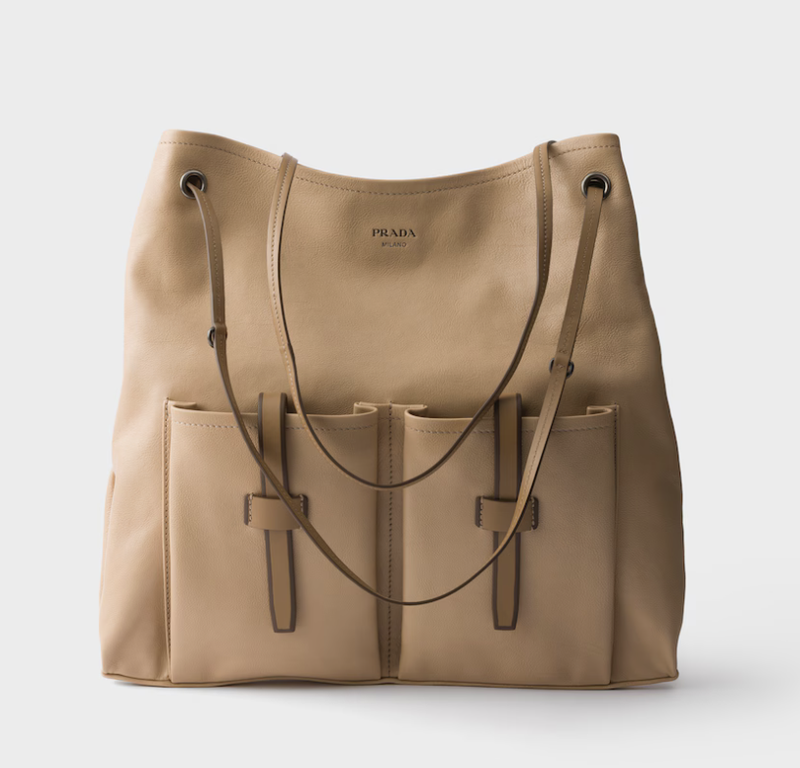
Saffiano or Re-Nylon: which to choose, and which gets copied more
If you’re weighing a purchase and not just checking authenticity, the choice usually comes down to two families, each with a different risk profile when buying outside the boutique.
- Saffiano (leather). More formal and more resistant to daily wear: the wax finish shrugs off scratches and rain, making it the right choice for the office or for anyone who wants a bag that lasts for years without much fuss. It’s also the most imitated, because the embossed texture looks easy to replicate — which is exactly why fakes give themselves away fastest, at the edges and folds.
- Re-Nylon (fabric). Lighter and more casual, suited to everyday use and travel; it holds up better under weight and cleans easily. Fakes here tend to chase the silhouettes that went viral, like the Re-Edition, and usually get the hand-feel of the fabric and the lining wrong. If you want the lowest-commitment way into the brand, this is it.
The same rule applies to both: the more famous the model, the more it circulates as a counterfeit, and the more it pays to buy it from a channel that stands behind its authenticity.
Price, and where to buy the real thing
Price remains the most honest signal of all, because it’s the one thing that can’t be faked. At retail, Prada bags start at roughly €900–1,000 for the smallest Re-Nylon pieces and comfortably exceed €3,000–5,000 for the more structured leather lines, with meaningful variation by line, size, and material — for the exact price of a specific model, it’s always worth checking the official Prada website. That said, the maths is simple: if someone offers you a “brand new, tags on” Prada bag for £120, that price doesn’t even cover the leather on a genuine one.
For secondhand, the logic shifts but the caution shouldn’t. A 30–50% discount on a model from a few seasons back is plausible; a 90% discount on a current piece never is. Favour sellers with plenty of reviews, insist on real photos rather than catalogue images — close-ups of the logo, the inner label, the zip pulls — and be wary of listings with a single photo. A seller acting in good faith is happy to send extra photos on request; one who gets defensive is telling you something.
More from Purse & Co
If you’re building out your knowledge of authentication basics, we’ve also covered how to spot a fake Gucci bag and how to spot a fake Louis Vuitton bag — the details change, but the method stays the same.
FAQ
Where is the serial number on a Prada bag?
Inside the bag, almost always in a pocket or on a leather tab sewn to the lining. It carries an alphanumeric code, stamped or printed cleanly, without smudging and properly aligned.
Can you verify a Prada serial number online?
No. Prada offers no public service to check serial numbers online — websites claiming otherwise are promising something that doesn’t exist. For a reliable check, contact the brand’s customer service, a boutique, or an authorized retailer.
What does the authentic Prada logo look like?
It’s an inverted triangle with “PRADA” in capitals and, in the full version, “MILANO” and “DAL 1913” beneath it. On a genuine bag the plaque sits straight with no excess glue, the letters are of even thickness and spacing, and the “R” has its distinctive leg with a small opening.
Is a Prada bag without an authenticity card fake?
Not necessarily. Prada doesn’t issue duplicate cards, so on a used piece that’s a few years old it may simply have been lost. The reverse is also true: the card gets counterfeited along with the bag, so on its own it proves nothing. What counts is the sum of the details, not a single card.
How much does a genuine Prada bag cost?
At retail, prices start at roughly €900–1,000 for small Re-Nylon pieces and exceed €3,000–5,000 for more structured leather lines, depending on model and size. Secondhand, a 30–50% discount on past seasons is normal, while a price of a few hundred euros for a “new” current model is almost always a sign of counterfeiting.
Disclosure: this article may contain affiliate links. If you buy through these links, Purse & Co may earn a small commission, at no extra cost to you.