
To spot a fake Celine bag you need three things to agree with each other: the wordmark, which the house redrew in September 2018 and which therefore dates whatever you are looking at; the Triomphe clasp, whose weight and proportions are the hardest part to copy; and the interior stamp with its date code, which is not a serial number and cannot be checked against any database. Everything else — the cut of the leather, the edges, the lining — follows from how the bag was built. Here are the checks in the order that actually helps.
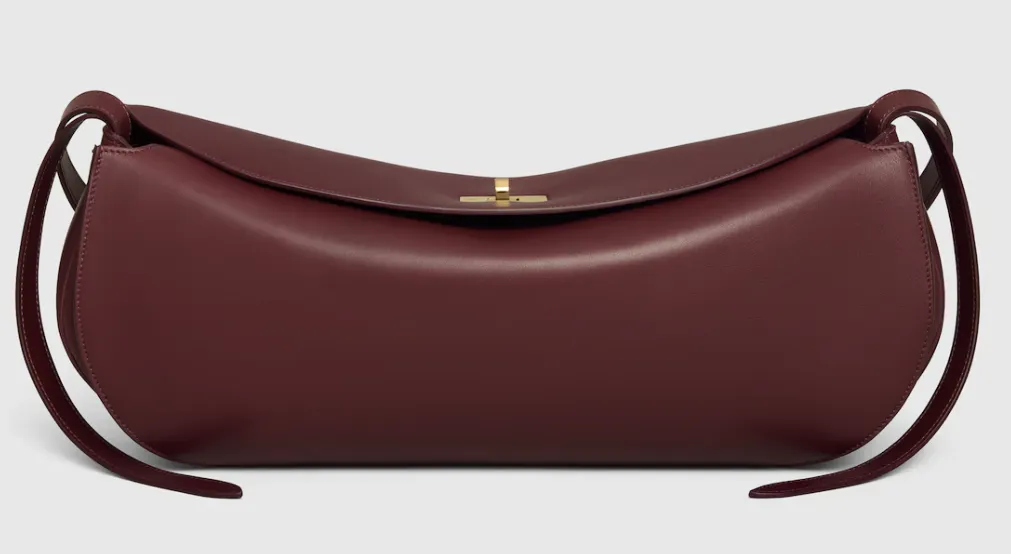
The wordmark dates the bag, and fakes mix the eras
Start with the name, because Celine gave everyone a free dating tool. On 3 September 2018, shortly after Hedi Slimane took over as artistic director, the house changed its wordmark: the accent came off the first E, and the spacing between the letters was tightened. The brand presented it as a return to its own 1960s logo, and announced it by posting the new mark on Instagram after deleting the entire previous feed. The word Paris stayed on clothing labels and packaging, but came off the logo used in campaigns.
So the mark on a bag should match the era the bag claims to be from. A piece sold as current season carrying the accented CÉLINE contradicts itself. So does a Phoebe Philo-era Luggage or Box, presented as a 2012 or 2013 piece, stamped with the accentless CELINE. Counterfeiters copy from whatever photographs they have, and mixing a recent clasp with an older wordmark — or the reverse — is one of the most common tells on bags sold as vintage.
Be honest about what this proves, though: it dates a claim. A wordmark is the cheapest detail to reproduce convincingly, so use it to catch a contradiction, never as evidence on its own.
The Triomphe clasp: a chain link, not a pair of letters
The gold fastening on most current Celine bags is the Triomphe, and knowing what it actually depicts changes what you look for. The house’s own account is that in 1971 founder Céline Vipiana, stopped near the Place de l’Étoile in Paris, noticed that the chain ringing the Arc de Triomphe was made of interlocking links, and adapted the shape as the maison’s emblem. It was used for years as the Blazon Chaîne, then fell out of use for decades, until Slimane pulled it out of the archive and reintroduced it as the Triomphe on the bags shown for Spring 2019.
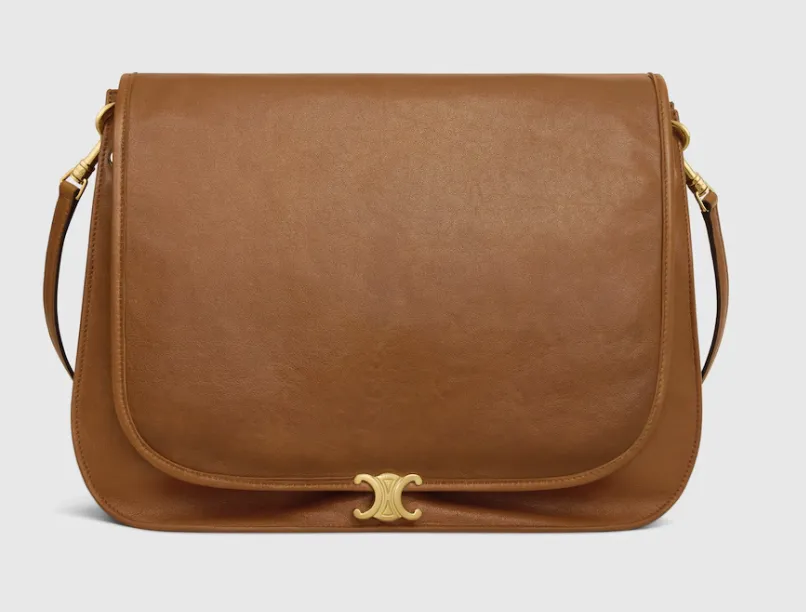
That means it is a link motif, not a monogram of letters, and the two loops interlock at a fixed angle. On a genuine bag the piece is solid and noticeably heavy for its size, the metal has a soft, slightly warm finish rather than a mirror shine, and it sits flat against the leather with no gap underneath. On copies it is usually thin and light, the two loops are set slightly too far apart or too upright, and the plating has already dulled or lifted at the raised edges. Pick the bag up: hardware is one of the few things a counterfeiter cannot fake cheaply, because the cost is in the metal itself.
Where we would stop is the typographic rabbit hole. Plenty of guides will tell you the exact curvature of the C or how the diagonal of the N should end. Those rules circulate on the blogs of paid authentication services and are not published by the house, they change from one production run to the next, and chasing them tends to make people confident about the wrong thing.
Leather, canvas, and how the bag is actually built
Celine’s leather goods are made in Italy, and the detail is worth knowing because it sets the standard the bag in front of you has to meet. The house has produced in Tuscany since 1979, first at Impruneta and from 1993 at Strada, and in October 2019 it opened a purpose-built plant at Radda in Chianti — around 5,200 square metres, employing over 400 artisans, where the Triomphe, the Trio and the 16 pouch are made. Hides come from Italian partner tanneries certified by the Leather Working Group, and a single Triomphe can take up to three weeks to finish.
Three weeks buys things you can see. The hide is read before it is cut, so the grain runs consistently across the panels and the front does not look like a different animal from the side. Seams are straight and evenly tensioned. Edges are properly finished rather than raw or thickly painted over. On a copy the giveaway is usually cumulative rather than dramatic: slightly puckered stitching at the corners, a lining that bunches, an edge coating that is already cracking on a bag described as unused.
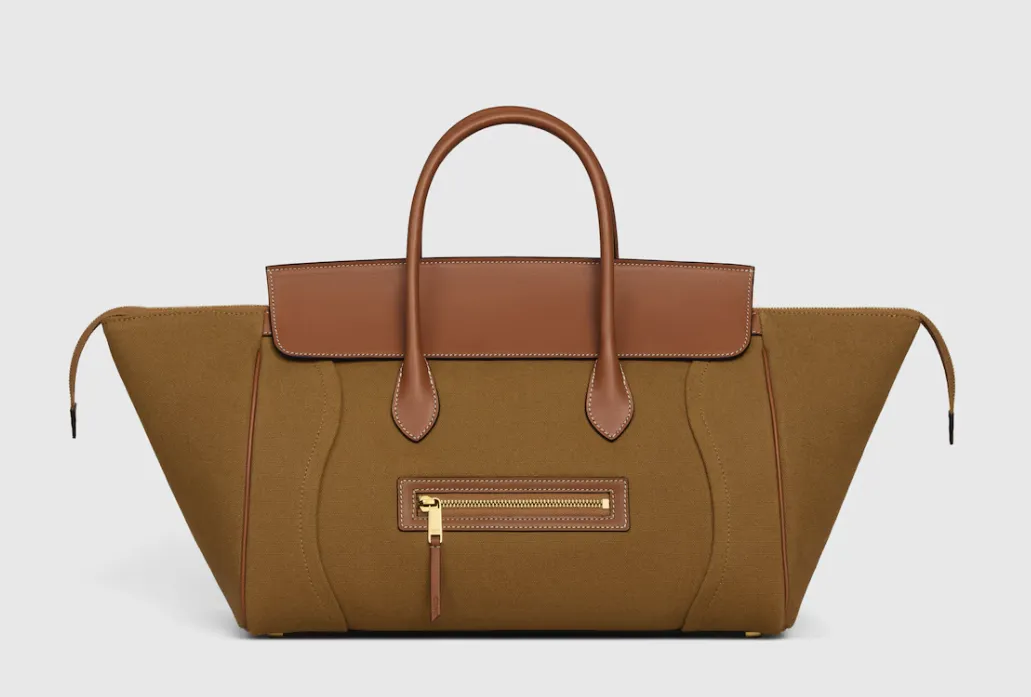
The canvas lines deserve a separate note, because that is where most of the cheap fakes live. Triomphe Canvas is a coated canvas printed with the repeating link motif, trimmed in calfskin and lined in fabric — cheaper to imitate than a full leather bag, so it is copied far more often. Two checks do most of the work: whether the printed motif lines up across the seams instead of breaking mid-pattern, and the quality of the calfskin trim. The fabric is easy to approximate; the handles, piping and reinforcement patches are not, and that is where the corners get cut.
The interior stamp and the date code
Inside, the stamp gives the house name and, below it, the country of manufacture. Current leather bags read Made in Italy; older pieces can legitimately read Made in France, which is why the stamp has to be read together with the wordmark and the model, not in isolation. The impression should be cleanly pressed into the leather at an even depth, sitting straight, with the letters evenly spaced.
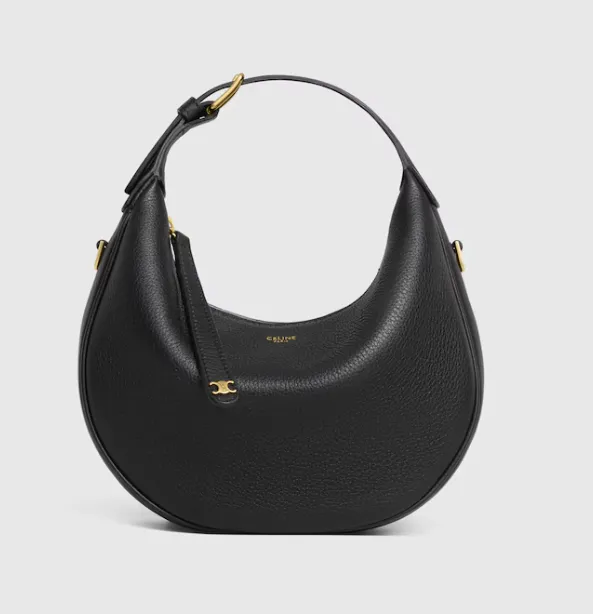
Then there is the code, and this is where most buyers are misled. Celine does not use a serial number. It uses a date code: a short combination of letters and digits, embossed on a small leather tab inside the bag or pressed into the lining, recording where and when the piece was produced. Because it records a production batch rather than an object, the same code can appear on many different bags. It identifies nothing about the specific bag in your hands.
Two consequences follow, and both are worth saying plainly. First, there is no public database: any website offering to check a Celine serial number is selling a service the house does not provide. Second, the decoding schemes that circulate — this letter is that factory, those digits interleave into a week and a year — come from resale platforms and paid authentication blogs, not from Celine, and we have not been able to trace any of them back to the brand. Read the code as one detail that has to be consistent with everything else. A missing or unreadable tab on an older bag is not proof of anything either; leather tabs wear.
Price, and where Celine actually sells
Price remains the most honest filter. Celine publishes no single global price list and figures move with VAT and currency, but the order of magnitude is not in doubt: across the core European line-up, prices run from roughly 1,250 euros for a small canvas shoulder bag to around 3,300 euros for a medium Classic Box in leather, with the Classique Triomphe sitting at about 3,000 euros. For the current range and exact figures in your country, the source to use is the official Celine website.
With those numbers in view, a “brand new, tags attached” Celine bag for 200 euros does not exist — that does not cover the leather, let alone three weeks of work. Secondhand, the scale shifts but the logic holds: a 20 to 40 percent discount on a recent model is plausible, 90 percent never is.
The distribution question settles the rest. Celine’s own terms of sale state that the house “only sells through its own distribution network and carefully selected partners” and “does not offer its product for sale through street vendors, unauthorized retail locations or unauthorized websites”. In practice that rules out flash-sale sites and marketplace sellers claiming access to current-season stock. Buy from a boutique, from celine.com, from an authorised department store, or from a resale platform that authenticates before it ships.
If it is your first secondhand Celine, there is a sensible order of difficulty. The Classic Box, the Luggage and the Triomphe are the easiest to check, simply because thousands of reference photographs exist and any authenticator has seen hundreds of them. A rare seasonal shape in an unusual colour is the hardest, because there is little to compare it against — and that is precisely the kind of listing a bad-faith seller prefers. Ask for real photographs rather than catalogue images: the clasp up close, the interior stamp, the date code tab, the edges and the base. A seller acting in good faith sends them without being pushed.
None of this is a niche problem. In its Mapping Global Trade in Fakes 2025 report, the OECD, working with the EU Intellectual Property Office, put the global trade in counterfeit goods at 467 billion dollars in 2021, equal to 2.3 percent of world imports, and at 117 billion dollars for the European Union alone — 4.7 percent of everything the EU imports.
More from Purse & Co
The method transfers across houses, even though the details change. We have also covered how to spot a fake Chanel bag, how to spot a fake Louis Vuitton bag and how to spot a fake Burberry bag.
Frequently Asked Questions
Do Celine bags have a serial number?
No. Celine uses a date code, not a serial number. It is a short combination of letters and digits recording where and when the piece was produced, so the same code can appear on many bags and it identifies nothing about your specific one.
Where is the date code on a Celine bag?
It is usually embossed on a small leather tab inside the bag, often tucked into an interior pocket, or pressed directly into the lining. The position varies by model and by year, and on older bags the tab can be worn to the point of being unreadable.
Can you check a Celine bag online by its code?
No. There is no public database, and any website offering to verify a Celine serial number is selling a service the house does not provide. The decoding schemes that circulate online come from resale platforms and paid authentication blogs, not from Celine.
Why do some bags say CELINE and others say CÉLINE?
The house redrew its wordmark on 3 September 2018, removing the accent from the first E and tightening the letter spacing, as a return to its 1960s logo. Pieces from before that date carry the accented mark, later ones do not, which makes it a useful way to date what a bag claims to be.
Are Celine bags made in Italy?
Current leather bags are. Celine has produced in Tuscany since 1979 and opened a plant at Radda in Chianti in October 2019, where over 400 artisans make the Triomphe, the Trio and the 16 pouch. Older pieces can legitimately be stamped Made in France.
How much does a real Celine bag cost?
Across the core European line-up, prices run from roughly 1,250 euros for a small canvas shoulder bag to around 3,300 euros for a medium Classic Box in leather, with the Classique Triomphe at about 3,000 euros. Figures move with VAT and currency, so check the official site for your country.
Article by the Purse & Co Editorial Team.
Disclosure: this article may contain affiliate links. If you buy through these links, Purse & Co may earn a small commission, at no extra cost to you.