
Spotting a genuine Louis Vuitton bag comes down to the whole picture, never a single clue: the Monogram canvas should have a crisp print that lines up perfectly along the seams, the mustard-yellow stitching should be tight and even, the natural vachetta leather should smell like real hide and darken with age, and the brass hardware should feel heavy with sharply cut engravings. Since 2021, Louis Vuitton has replaced the old date code with an NFC microchip hidden in the lining. No counterfeiter gets every one of these right at once — it’s the combination that tells you whether a bag is genuine. Below, point by point, here’s what to look for, and where to buy the real thing with confidence.
One honest caveat up front: this guide is meant to protect buyers, not to serve as a foolproof detector for every fake out there. The best counterfeits — the so-called “super fakes” — keep getting better, and the only absolute certainty comes from Louis Vuitton itself or a professional authentication service. But learning to read the right signals will save you from the most common mistakes, especially when buying secondhand.
Materials and leather
Your hands are the first judge. The famous Monogram canvas isn’t fabric at all — it’s coated cotton (a waxed canvas): smooth and firm to the touch, slightly stiff, never plasticky or tacky. The checkerboard Damier canvas follows the same rules of sharpness. Be wary of anything that feels shiny like plastic or smells of chemical glue.
The vachetta leather trim (handles, tabs, edges) is the house’s signature: it’s natural, untreated leather, pale cream when new, that develops a warm honey patina with use and light exposure. On an authentic, well-worn bag, the vachetta will be darker and lived-in; on many fakes it looks artificially “aged” in a uniform way, or stays a plasticky beige that never changes. It should smell like real leather, not varnish.
The logo, monogram, and symmetry
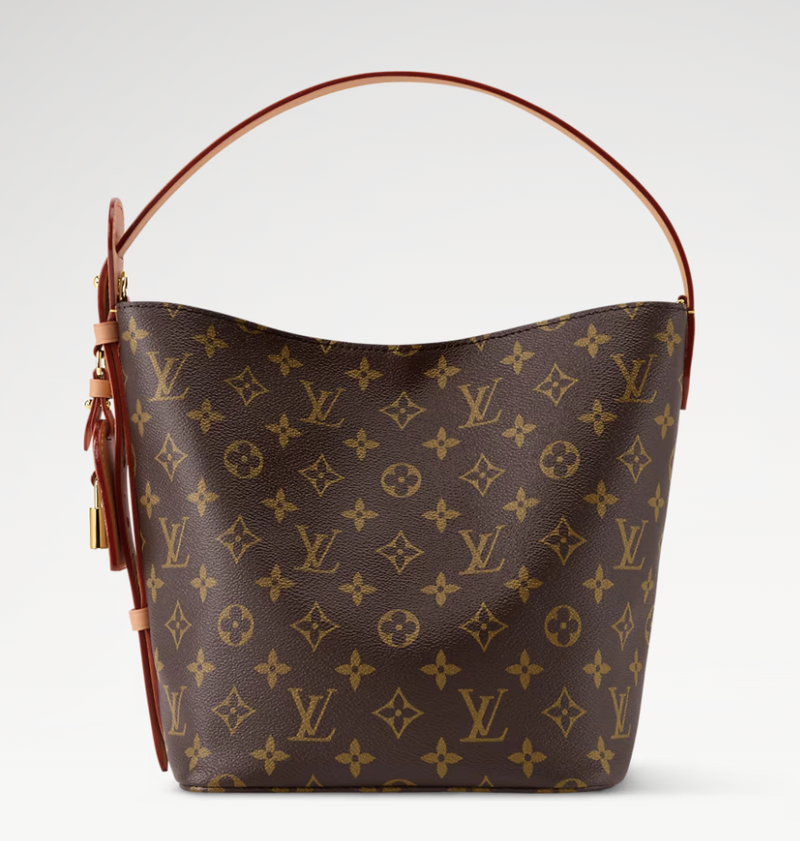
The Monogram is built from three motifs alternating diagonally: interlocking LV letters, a four-petal flower inside a circle, and a stylised diamond flower. On an authentic bag, the pattern is symmetrical, even, and aligned — and, crucially, it matches up along the seams: where two panels meet, the design continues without a break. Fakes, trying to save on canvas, often cut the pattern short and let it misalign at the edges.
One detail that throws people off if they don’t know it: on some pieces cut from a single length of canvas (the Speedy, for instance), the LV letters can appear upside down on one side. That’s not a flaw — it’s normal, and actually a small sign of authenticity, since it comes from how the canvas is folded during construction. What should worry you instead is an LV letter cut off in the wrong place, or uneven lettering — letters that are too wide, slanted, or blurred are suspicious.
Stitching, finishing, and hardware
Stitching on a Louis Vuitton bag is tight, straight, and even, with no loose threads or skipped stitches. The thread is almost always a distinctive mustard yellow (originally white linen, dyed and treated with beeswax): a warm, muted tone, never neon yellow or bright orange as you’ll see on fakes. Every model has a precise, consistent stitch count — on double handles, for example, the number of stitches on one handle mirrors the other exactly. Uneven stitching, a thread that’s too bright, or random spacing are among the most reliable signs of a copy.
Hardware — buckles, clasps, the lock, zippers, studs — is made of plated brass: it should feel heavy and solid, with an even finish, no bubbling or flaking plating (genuine wear reveals gold-toned brass underneath, not grey metal). The Louis Vuitton or LV engravings on the metal are crisp and well-defined. Many models come with a numbered lock, with the matching number stamped precisely on the key. Lightweight metal, a zip that snags, or plating that chips off right away all point to poor construction.
Date code, NFC chip, and the tag
Until recently, Louis Vuitton used a date code: a small code stamped into an inner corner, on a tab, or along a seam, usually made of two letters and four numbers. The letters indicate the factory, the numbers the week and year of production (under the system used since 2007). It’s worth knowing that the date code is not a serial number or a certificate of authenticity — it only tells you when and where the bag was made, and counterfeiters copy it too, so it should always be cross-checked against everything else.
Since March 2021, Louis Vuitton has gradually phased out the date code, replacing it with an NFC microchip built into the lining, in a specific spot that isn’t visible to the eye. The chip can’t be read with ordinary consumer apps — only the house and professional authenticators, using dedicated tools, can verify its presence and correct position. So on recent models, having no date code at all is completely normal and not a flaw.
A word on a common myth: Louis Vuitton does not include “certificates of authenticity” with its bags. If a seller shows you a card labelled “certificate of authenticity” as the main proof, be cautious — that’s often exactly what accompanies fakes. What matters is the bag itself — the leather, the canvas, the stitching, the hardware — not the paperwork.
Price, and where to buy the real thing
Price is a clue, not proof — but a deal that looks too good is almost always hiding something. As a rough guide for 2026 in Europe, a Neverfull MM in Monogram canvas runs around €1,700–1,800, and a Speedy Bandoulière 25 starts at roughly €1,500–1,600 (prices vary by model, size, and material, and Louis Vuitton adjusts pricing every year). A “new” Louis Vuitton bag offered for a few hundred euros outside official channels is almost certainly not genuine.
One detail that helps a lot: Louis Vuitton never discounts, has no outlets, and doesn’t sell through multi-brand retailers. You’ll only find the real thing here:
- Louis Vuitton boutiques and the official site, louisvuitton.com: guaranteed authenticity, with a receipt and after-sales service. There are no official outlets or clearance stores.
- Authenticated resale platforms (for example Vestiaire Collective, Rebag, The RealReal): every piece is checked by an authentication team before it ships. Read the policy carefully and keep your receipt.
- A professional authentication service for secondhand pieces bought privately: a modest cost that protects you from “super fakes”.
Avoid unmoderated marketplaces with anonymous sellers, social media shops, and “parallel” channels — that’s where counterfeits concentrate. And if you have a real doubt about a piece you already own, the simplest move is still to visit a Louis Vuitton boutique or use a professional authenticator.
A transparency note: this guide is for information and buyer-protection purposes. We don’t promote or link to counterfeit products, and we don’t provide instructions for reproducing them.
More from Purse & Co
If you’re building out your knowledge of authentication basics, we’ve also covered how to spot a fake Gucci bag, how to spot a fake Chanel bag, and how to spot a fake Prada bag.
FAQ
Does the date code prove a Louis Vuitton bag is genuine?
No. The date code only shows the factory and production date — it’s not a certificate of authenticity, and counterfeiters copy it too. Always cross-check it against the leather, canvas, stitching, and hardware. Since 2021, Louis Vuitton has replaced it with an NFC microchip, so on recent models having no date code at all is normal.
How can you identify a genuine Louis Vuitton by its stitching thread?
Authentic stitching is tight, even, and a distinctive mustard yellow — a warm, muted tone. Neon yellow or bright orange thread, uneven stitches, or loose threads are strong signs of a fake. Each model also has a consistent stitch count that mirrors between the two handles.
Why are the LV letters upside down on one side of my Speedy?
That’s normal and doesn’t indicate a fake. Some models, like the Speedy, are cut from a single folded piece of canvas, which is why the Monogram can appear upside down on one side. It’s actually a detail consistent with authentic construction.
Does Louis Vuitton include a certificate of authenticity?
No. Louis Vuitton doesn’t provide cards or certificates of authenticity with its bags. If a seller presents a “certificate” as the main proof, treat it as a warning sign — it often accompanies fakes. What matters is the bag itself, not the paperwork.
Does a low price always mean a bag is fake?
Not always, but it’s a strong warning sign. Louis Vuitton never discounts, has no outlets, and doesn’t sell through third parties, so outside official channels a “new” bag for a few hundred euros is almost certainly not authentic. For secondhand pieces, stick to platforms that authenticate items before they’re sold.
Disclosure: this article may contain affiliate links. If you buy through these links, Purse & Co may earn a small commission, at no extra cost to you.