
To spot a fake Bottega Veneta bag you read the weave, because there is no logo to read. That is the whole method in one line: if the leather strips genuinely pass over and under one another, all the same width, held in place by tension rather than by thread, you are most of the way there. If the pattern has been pressed into one continuous piece of leather, you can stop — none of the other checks will save it.
It helps to drop the check most buyers reach for first, which is hunting for a logo. On a Bottega Veneta there has never been a large visible one. The house built sixty years of identity on the line “When your own initials are enough”, so the question “where is the logo?” leads nowhere, and a conspicuous plaque stitched to the front is on its own a reason to walk away.
Why copies get the weave wrong
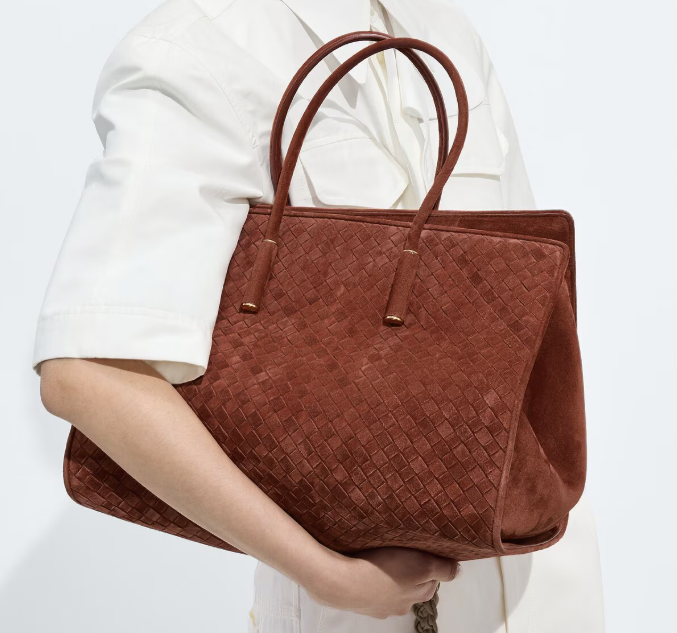
The intrecciato did not start as decoration. Bottega Veneta opened in Vicenza in 1966, founded by Michele Taddei and Renzo Zengiaro, and the braid arrived as an engineering fix: the workshop’s sewing machines could not handle heavy leather, so lighter leather was cut into strips and woven, which made a bag both durable and soft. The house has changed hands since — Gucci bought it in February 2001, and it sits today inside Kering — and changed creative director several times, most recently with Louise Trotter, who arrived from Carven at the end of January 2025 in succession to Matthieu Blazy. The weave stayed.
That is exactly why copies give themselves away there. Weaving hundreds of strips by hand is labour, and labour is the one line a counterfeit has to cut to make its numbers work. The fastest way to remove it is to emboss the pattern onto a single sheet of leather or synthetic. From two metres away it works. Up close it does not.
The scale of the real work is worth knowing, because it sets the standard the bag in front of you has to meet. The Cabat, introduced in 2001 under Tomas Maier, is woven by two artisans over two full days: double-faced leather strips built up over a wooden form, with no lining, so the bag has to look the same inside as out. Since October 2023 the house has run its own school, Accademia Labor et Ingenium, split between the atelier at Montebello Vicentino and the plant at Povolaro Dueville — fifty students a year, taught by five master artisans, with a job at the end.
Woven or embossed: the test that works on a photograph
On a genuine intrecciato the strips really do pass over and under. Micro-gaps stay open between them, and the surface catches light differently along the two directions of the braid. There is no stitching running across the strips to hold them down: the weave stays put through tension, not thread. Stitches pinning the pattern in place mean the bag was built another way.
Embossed leather is one sheet passed under a die, and it shows in three places. The motif repeats identically for ever, there are no gaps between the false strips, and at the corners the pattern stays perfect — which is the one thing a real braid cannot do, because at a corner the strips have to bend and the mesh tightens slightly. On a resale listing, enlarge a bottom corner and the edge of one side. That is where it settles.
This is not a reason to distrust embossing in general. Prada’s Saffiano is embossed by design and declared as such, and in our guide on how to spot a fake Prada bag it is one of the starting materials. The problem begins when embossing is sold as weaving.
Fine weave, wide weave, one rule
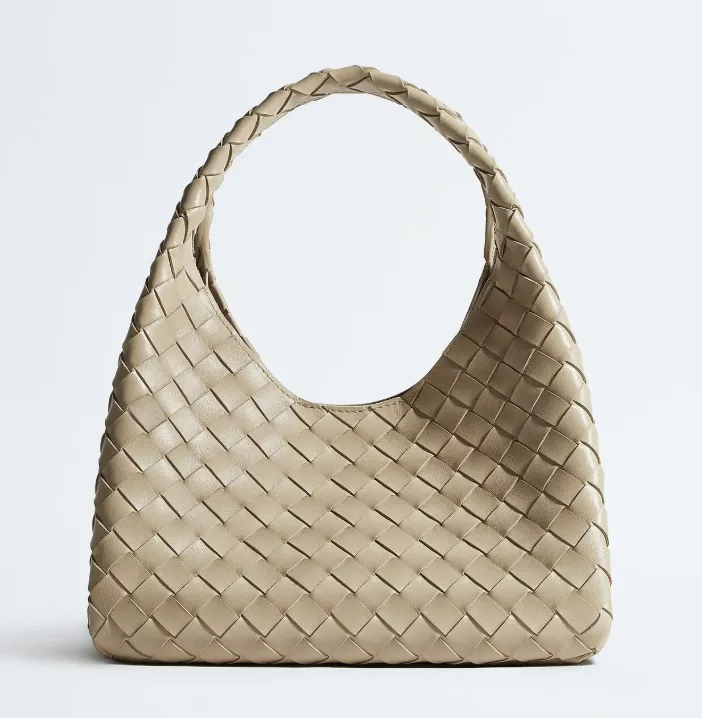
Anyone who knew the brand in the 2000s pictures the small tight braid of the soft bags of that period. More recent collections have brought a much wider mesh, with thick strips and an almost sculptural relief. Both are legitimate, which sends people wrong when they have only one picture in their head: “the strips are too wide, it must be fake” is not an argument that holds.
The rule that does hold is a different one. Within a single bag the width of the strips never changes. Nor does the tension, nor the diagonal the mesh runs on. If the braid is tight across the front and loosens on the side, if one strip is visibly thinner than its neighbours, if the diagonal tilts differently on two panels, the bag was made in a hurry. There is a physical tell too: a genuinely woven panel flexes and falls soft, while a copy stays stiff like card.
Where the name is actually written
The name is there, but it lives in two places only. The first is the heat stamp inside — small, in capitals, tidy. The letters have to be crisp, pressed to an even depth and squarely aligned. Lettering that is smudged, crooked or deeper at one end is one of the most common faults on copies, because it is the single part of the bag that needs a precise machine.
The second is the metal fittings: the name appears engraved small on zips, rings and closures. The cut is shallow and legible only close up, never a display plaque. Weight counts here as well. On a bag costing several thousand euros the closures and hooks are solid, cold to the touch, and move without play.
What should not be there is a large logo inside. Linings covered in repeated wordmarks do not belong to this house: the bags that made its recent reputation were designed with no identifying mark on them at all.
The label inside, and what the Certificate of Craft actually proves
Inside almost every bag, usually in an awkward corner of a pocket, there is a small label carrying a string of letters and numbers. Listings call it a serial number. It is not one. That string combines the model code, the material code and the colour code, so it identifies the type of bag rather than the individual bag: two identical pieces made the same month carry the same string. The decoding tables that circulate online are conventions among resellers, not documents published by the house. They are useful for noticing an inconsistency, not for proving anything.
The closest thing to a per-item identifier is the Certificate of Craft, the repair programme introduced in November 2022. A bag bought new comes with a card, physical and digital, carrying a unique number tied to that bag, and in exchange the owner gets unlimited repairs and refreshes at no cost and with no expiry date. It only applies to purchases made from November 2022 onwards, and it started on a selection of the house’s bags rather than the whole catalogue. On an older bag its absence proves nothing; on a recent one being sold as new, it is worth asking why it is missing.
Price, and where to buy without gambling
At authorised retailers a new bag runs from roughly 1,100 to 7,100 euros depending on model and size. Reading across the offers listed by authorised retailers in August 2026 — a little under two hundred of them — a Loop mini sits around 2,200 euros, a Jodie mini around 2,500, a Veneta baby around 2,600, a Jodie small around 3,500 and a Campana large around 5,500, up to 7,100 euros for the Andiamo large in denim. These are European retail figures and they move, so for today’s price where you live, the boutique and the official site are the source.
You do not really need the absolute number, though. You need the ratio. Look up what the exact model costs now, then measure the listing against it. A recent bag in good condition, sold secondhand, plausibly lands twenty to forty percent below retail. Ninety percent below is not a bargain and not a seller’s mistake — it is the price of a different object. A new Bottega Veneta does not cost a few hundred euros, and a listing at that figure is selling something else.
On the resale market, prefer a platform that routes the bag through a checking hub before it ships, and understand where that stops. On Vestiaire Collective, for example, direct shipping — the option that skips the physical check — is offered on items priced at 1,000 euros or less, so below that threshold going through the platform is not an authentication. If the doubt survives all of this, booking a repair at a boutique is the most direct way to have the bag looked at by the people who make them.
Once it is yours, the weave asks for little but asks regularly: keep it away from heat and feed the leather, or the strips dry out and the edges begin to fray.
More from Purse & Co
The method carries across houses even when every detail changes. We have also covered how to spot a fake Celine bag and how to spot a fake Saint Laurent bag.
Frequently Asked Questions
Do Bottega Veneta bags have a serial number?
Not in the sense of a code unique to each bag. The interior label carries a string combining the model code, the material code and the colour code, so it identifies the type of bag rather than the individual piece. The only number tied to a single bag is the Certificate of Craft number, which exists only on bags bought new from November 2022 onwards.
How do you tell a real intrecciato from an embossed pattern?
Look closely at a corner. In a real weave the strips pass over and under and leave micro-gaps, and at the corners the mesh tightens slightly because the leather has to bend. Embossed leather is a single sheet: the motif repeats identically, there are no gaps, and the pattern stays perfect even at the edges. On a genuine bag there is also no stitching running across the strips.
Where is the Bottega Veneta name on a genuine bag?
In two places only: the heat stamp inside, small and in capitals, and the engraving on the metal fittings, meaning zips, rings and closures. There are no badges on the front and no linings covered in repeated wordmarks. The house was built without a visible logo and has stayed that way.
How much does a real Bottega Veneta bag cost?
At authorised retailers a new bag runs from roughly 1,100 to 7,100 euros depending on model and size: a Loop mini sits around 2,200 euros, a Jodie small around 3,500, a Campana large around 5,500. These are European figures read in August 2026, and for today’s price where you live the boutique and the official site are the source.
Does the Certificate of Craft help if I buy secondhand?
Only if the bag was bought new from November 2022 onwards and the seller passes the card on with it. On an earlier model it never existed, so its absence says nothing about authenticity. On a recent bag being sold as new, it is worth asking why it is missing.
Article by the Purse & Co Editorial Team.
Disclosure: this article may contain affiliate links. If you buy through these links, Purse & Co may earn a small commission, at no extra cost to you.